A milestone. A medicine supply crisis. One uncomfortable question.
Boots is in. Why are families still fighting?
A household name enters medical cannabis. Families fear losing access to their children’s medicine. Both stories belong on the same front page.
It’s been a busy fortnight since the last WTF File. To everyone who has joined in the meantime, welcome.
This week, two stories deserve to be read together. Boots has entered the medical cannabis market. And a mother is publicly pleading for help because she fears her son could lose access to his medicine.
One story invites celebration. The other demands an answer.
Two stories, one week
Same week. Different worlds.The good news
A familiar name. A significant arrival.
Boots Online Doctor · 16 November 2026

On 16 November, Boots Online Doctor announced SureLeaf, a private medical cannabis service for eligible patients aged 25 and over. [1]
It offers specialist assessment and ongoing care for certain pain conditions, generalised anxiety disorder and insomnia, where conventional treatment hasn’t provided adequate relief.
That matters. A familiar healthcare name gives medical cannabis greater mainstream visibility. My hope is that it makes conversations easier for patients who have spent years feeling judged, dismissed or reluctant to talk about their treatment.
Boots also says it’s exploring research with the University of Nottingham. I want this sector to develop: responsible prescribing, better evidence, greater understanding and services patients can trust.
To be clear: Boots’ service is for adults. It doesn’t, by itself, solve the supply problem facing children, and Boots didn’t cause it.
Meanwhile…
A mother counting the medicine left.
BBC News · 20 November 2026
BBC reporting describes the situation facing Joanne and her 17-year-old son, Ben, who has severe drug-resistant epilepsy. [2]
Joanne says Ben has about five weeks of medication left, amid disruption following Bedrocan’s bankruptcy. His family says he has received Bedrolite and Bedica oils for seven years, and that his neurologist has advised against changing his medication.
“My son is going to die.”
Joanne, speaking to BBC News
The same report includes the government’s response. The Department of Health and Social Care says it has been speaking with suppliers and the Dutch government, and believes stocks can sustain supplies for the coming months while a longer-term solution is sought.
That response belongs in this conversation. So does the distance between an assurance about stock and a parent knowing their child’s next prescription will actually be supplied.
Bedrocan’s administrators have since given their account of what went wrong. A restart bid awaits court approval, and their report doesn’t say what it means for UK supply. [4]
Read Joanne’s story on BBC News (opens in a new tab)
Reporting by Georgie Docker and Thomas Mason.
I’ve been here since 2016
This is personal

I’ve been here since 2016.At the Charlotte’s Web plant nursery, 2017.
I have been supporting families in this space since 2016, before the 2018 law change and long before this week’s headlines about Boots.
I have seen the effort it takes for families to keep pushing for their children, often while exhausted and frightened about what comes next.
To still be having these conversations a decade later, and to see the gaps getting wider, is truly devastating.
I welcome the progress. But I can’t celebrate it without asking why families are still being left in such precarious circumstances.
We should remember how we got here
The role of children and their families in changing UK policy is on the record. The House of Commons Health and Social Care Committee recognised that the cases of Alfie Dingley and Billy Caldwell, and their families’ efforts to get treatment, led to a change in government policy. Certain cannabis-based medicines were rescheduled in November 2018, so specialists could prescribe them. [3]
Eight years later, there is a growing commercial sector and a household name entering it. Yet families are still having to turn their children’s circumstances into public campaigns for access and continuity.
These children helped make the need for reform impossible to ignore. Their stories should keep shaping what we call a successful system.
The WTF moment
Progress, but for whom?
A household name can now confidently enter the medical cannabis market. Yet families are still publicly pleading for continuity of their children’s treatment.
Eight years after the law changed. Ten years after I began supporting families.
What the frog? How are we still here?
Commercial confidence, parental fear
We talk about investment, patient acquisition, market development and the arrival of major brands. All of those conversations get harder to celebrate when a parent is counting down the medicine left in a bottle.
A regulator, a government, a manufacturer and a prescribing clinician each have different responsibilities. That complexity is exactly why coordination matters. Families need a clear account of how those responsibilities join up.
And that’s the bigger point. This space doesn’t lack knowledge or goodwill. It lacks cohesion: patient information, clinics, support and education are scattered across too many places, and families are left to join the dots.
The bottom line
The next milestone
There is a version of progress measured by launches, investment and market recognition. There is another measured by whether a parent can collect the next prescription without having to launch an emergency campaign.
I welcome Boots entering this space. I hope its involvement leads to better understanding and better care. I also want the sector’s growing confidence to be matched by visible responsibility towards the patients whose families helped bring this issue into public view.
If you work in government, regulation, prescribing, manufacturing or supply, here is the question I’d like answered: who owns the continuity plan, and when will families receive it?
The next milestone I want to celebrate is a parent being able to stop counting down.
Big love,
Jade x
Kindness is Contagious
Meanwhile, on my own desk
 (opens full size in a new tab)
The Clinics Concierge
One woman.Quite a few tabs open.
All of this has arrived during the launch period of The Clinics Concierge.
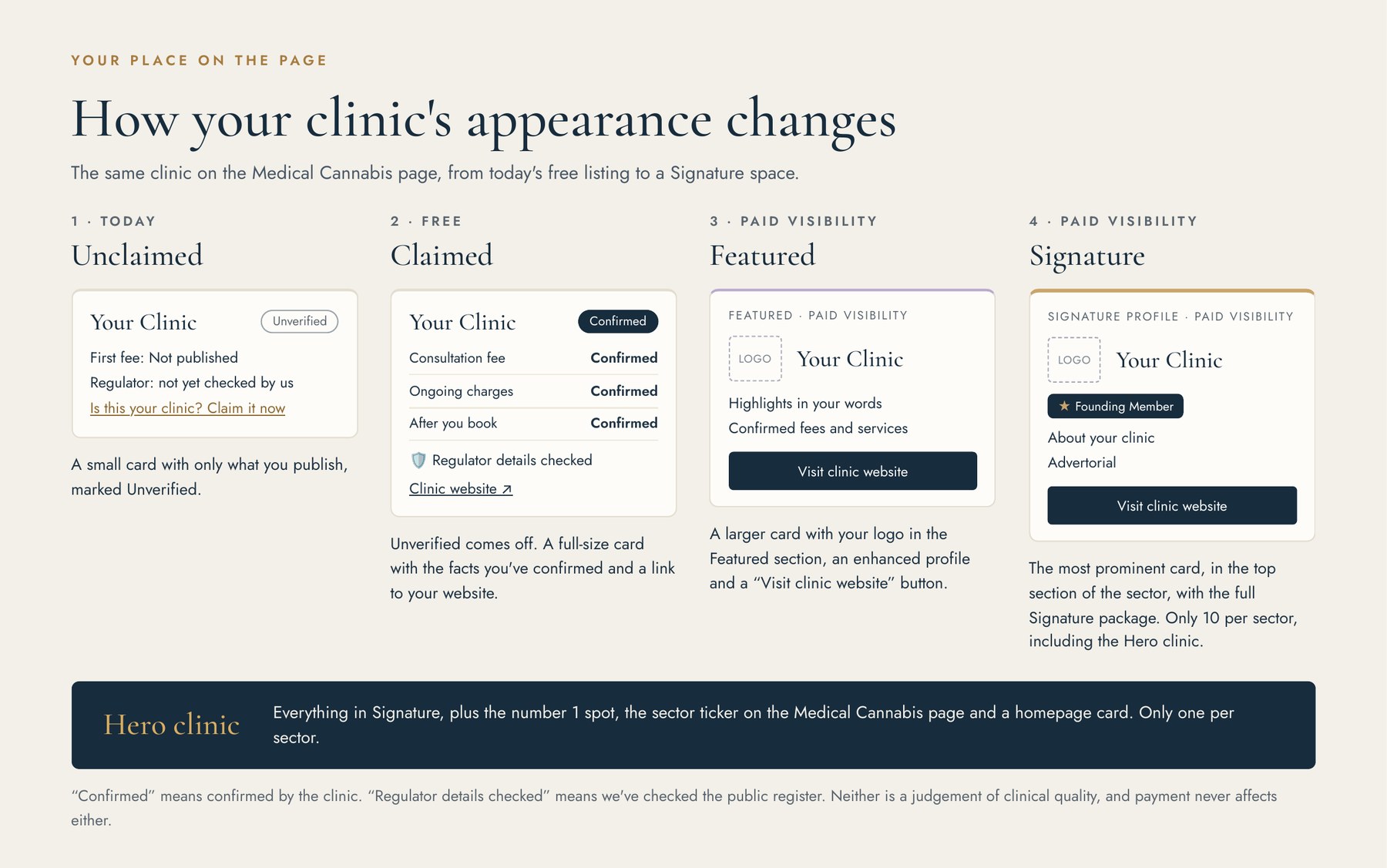
TCC is a community platform for service discovery and education. It’s free at the point of use for anyone looking for help, and that’s possible because clinics partner with TCC on a paid basis to showcase their services and what they offer.
Last weekend I shared a video on LinkedIn (opens in a new tab) with a simple call to action: this space needs cohesion. One place where patient information and the clinics available come together, so people stop having to piece it together alone.
TCC’s growth dashboard shows a combined 27k eyeballs in its first 17 days. The interest has arrived faster than I expected.
Claiming a listing and correcting it are free. Paid visibility is always labelled, never changes a clinic’s facts, and is what patients see first: there are only 10 Signature spaces in each sector, across Medical Cannabis, ADHD & Autism and Menopause.
- Signature spaces per sector10 MEDICAL CANNABIS · ADHD & AUTISM · MENOPAUSE
Founding members wanted. Every founding space is still open. The clinics that take them first will be the first clinics patients see: social proof for their brand from day one, and a visible sign that they back a new, cohesive patient access platform.
Now’s the time to own your space. Use your profile to show the people looking for help exactly what you offer, and why they can trust you.
Talk to me about founding membership (opens the TCC For Clinics form in a new tab)
Opens the For Clinics form on The Clinics Concierge. Choose “Ask about a paid profile or add-on”.
The resource bank, however, is still quite empty. I want to be honest about that. I’m contacting clinics myself, asking them to take part and contribute. There’s a lot of work between recognising a resource is needed and filling it with useful contributions.
If you’re a clinic or industry professional with a useful resource to share, I’d welcome that conversation.
Contribute to the TCC resource bank
Or email service@theclinicsconcierge.com
theclinicsconcierge.com (opens in a new tab)
There’s a lot for me to digest this weekend.